
The Judge Opened the DNA File — Then Silence Fell as the Mistress’s Forged Lies Crumbled

Previously: A six-year-old boy faces a scheming mistress who faked DNA tests to steal his inheritance. But when the judge cracks the seal on the court file, the truth explodes — and everyone learns who really betrayed the family.
The Bank Vault's Secret
The next morning, Judge Locke drove me to the First National Bank in his old black sedan. The streets were quiet, the sun just beginning to rise over the vineyards that stretched as far as I could see. I had never been inside the bank before. It smelled like old paper and floor wax, and the teller behind the counter looked at us with a mixture of curiosity and respect when the judge flashed his badge.
“We need access to a safety deposit box,” Judge Locke said. “Ethan Whitmore’s name is on the lease.”
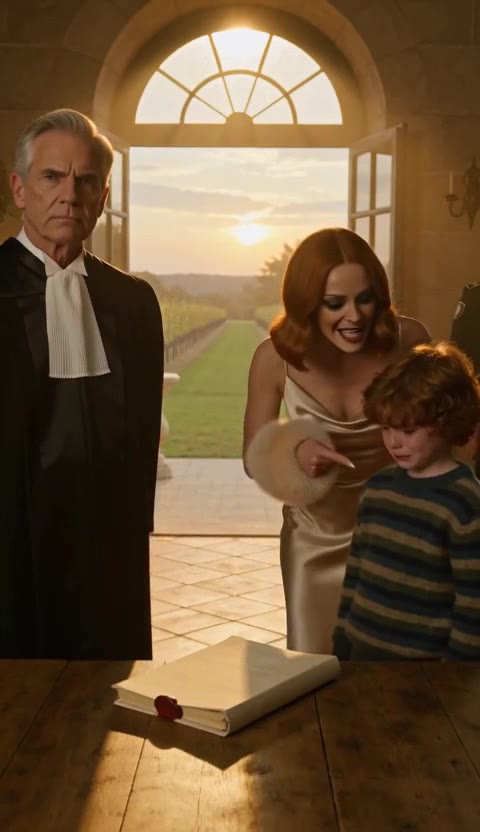
The teller checked the records, then led us down a long hallway lined with brass doors. She stopped at number 214 and inserted her key. Judge Locke inserted the silver key from the music box. Together, they turned them, and the door swung open.
Inside was a single manila envelope, yellowed with age. Judge Locke took it out and closed the door. He didn’t open it right away. Instead, he led me to a small room with a table and two chairs, and we sat down.
“Are you ready?” he asked.
I nodded, though my heart was pounding. The envelope was thicker than I expected. When Judge Locke opened it, a sheaf of papers slid out, along with a photograph — a picture of my mother, young and laughing, holding a baby in her arms. On the back, in her handwriting, were the words: “My son, my joy.”
But it was the papers that made Judge Locke’s breath catch. They were medical records, stamped with the seal of the county hospital, dated eight years ago. And they told a story that made the world tilt beneath me.
“Your mother was poisoned,” Judge Locke said, his voice barely a whisper. “Arsenic, administered over a period of months. The dosage was small enough to be undetectable at first, but it accumulated in her system until her heart simply gave out.”
I stared at the papers, but I couldn’t read them. The letters blurred together. All I could see was my mother’s face, pale and thin on her deathbed, telling me to be brave.
“Who?” I asked, though I already knew the answer.
Judge Locke’s jaw tightened. “There’s a witness statement in here. A nurse who came forward after your mother’s death, saying she saw Selena in the ward, administering medication that wasn’t on the chart. She was afraid to testify back then, but she kept a copy of the records.”
I felt the tears slide down my cheeks. I didn’t bother to wipe them away. “She killed her,” I said. “She killed my mother.”
Judge Locke reached across the table and took my hand. His grip was firm and warm. “She will answer for this,” he said. “I promise you that.”
The Trial of Selena Vance
The trial was held in the same courthouse where Judge Locke presided. The gallery was packed — townspeople, reporters, even the foreman from the vineyard. They all wanted to see the mistress who had tried to steal a child’s inheritance get her due.
Selena sat at the defendant’s table, her champagne dress replaced by a drab grey suit. She looked smaller somehow, diminished. Her eyes no longer held that cruel spark. They were flat and lifeless, as if she knew she was finished.
The prosecution laid out the evidence piece by piece: the forged crib logs, the bribed nurse, the counterfeit DNA report. And then came the medical records. The photographs of my mother, taken months before her death, showing her gaunt and hollow-eyed. The testimony of the nurse who had seen Selena with the syringe.
Selena’s lawyer tried to argue that the records were tampered with, that the nurse was unreliable. But Judge Locke had been meticulous. Every document was authenticated. Every witness was credible. And when the prosecution played the CCTV footage of Selena swapping the crib tags, the jury didn’t even need to deliberate.
They returned a verdict of guilty on all counts — forgery, fraud, attempted theft, and second-degree murder.
Selena was sentenced to twenty years in prison. As the bailiffs led her away, she turned and looked at me. Her eyes were empty, but her lips moved, forming words I couldn’t hear. I didn’t need to hear them. I knew what she was saying.
“This isn’t over.”
But it was. For the first time since my father died, I felt the weight lift from my shoulders. I was the heir to the vineyard, the son of Charles Whitmore. And I was free.
Judge Locke put his hand on my shoulder as we walked out of the courthouse into the bright sunlight. “Your mother was a brave woman,” he said. “She trusted me to protect you. And I will.”
“What happens now?” I asked.
“Now,” he said, “you learn to run the vineyard. It’s yours, after all.”
I looked out at the rows of grapevines, golden in the afternoon light. I could almost see my father there, standing between the rows, waiting for me. And I knew, with a certainty that filled my chest, that I would make him proud.
I pulled the music box out of my pocket. It was empty now, the secret gone, but I still held it close. My mother had given me the truth, and I had used it to win. As I walked toward the vineyard, I felt her hand in mine, and I smiled.
Sometimes the smallest key opens the heaviest door.

She Caught the Manager Burning Her Dad's Hands — Then He Learned Who She Really Was
A billionaire hotelier finds her elderly father working as a dishwasher on her own yacht, humiliated by a cruel manager. When she steps in, the truth shatters every illusion — and the manager's downfall is only the beginning.
📖 Read Full Story — Continue Here →More stories you'll love
 Part 1 of 312 min read
The Janitor’s Daughter Watched in Tears as the Chef Mocked Him — Until the Ceo Walked In
A humble janitor endures a chef’s cruel humiliation while his daughter watches in tears. But when a billionaire CEO storms in, the truth shatters everything — and the chef’s world collapses.
 Part 1 of 39 min read
She Caught the Manager Bullying Her Dad — Then Dropped to Her Knees and Made Him Cry
A billionaire heir returns to her father's humble workplace to find him humiliated by a cruel manager. What she does next leaves everyone speechless — and changes everything.
 Part 1 of 312 min read
He Humiliated the Dishwasher in Front of His Granddaughter — Then the Billionaire Son Walked In
A cruel chef makes a kind dishwasher kneel and scrub spilled soup. But when the dishwasher's granddaughter defends him, a billionaire in a bespoke suit steps in — and everything changes.
 Part 1 of 312 min read
He Humiliated the Dishwasher, Then His Daughter Walked In—and the Whole Club Froze
At the Royal Kensington Country Club, a cruel maître d' humiliates a humble dishwasher in front of his son. But when the billionaire hotelier daughter strides in, the power shifts—and the maître d' learns a lesson he'll never forget.
 Part 1 of 313 min read
The Janitor’s Daughter Saw Her Father Humiliated—Then the CEO Walked In
A cruel supervisor humiliates an elderly dishwasher while his granddaughter watches. But when a billionaire storms in and kneels beside them, the entire restaurant learns who truly owns the building.
 Part 1 of 313 min read
The Janitor Father Was Mopping the Ballroom Floor When the New Ceo Walked In — He Froze at Her Face
A ruthless banquet manager humiliates a dishwasher father in front of his little girl — until the billionaire CEO storms in, drops to her knees, and whispers two words that shatter the whole room.